


Cowboy Couture: Exhibit spotlights local roots and international reach of Western wear designer Jerry Lee Atwood
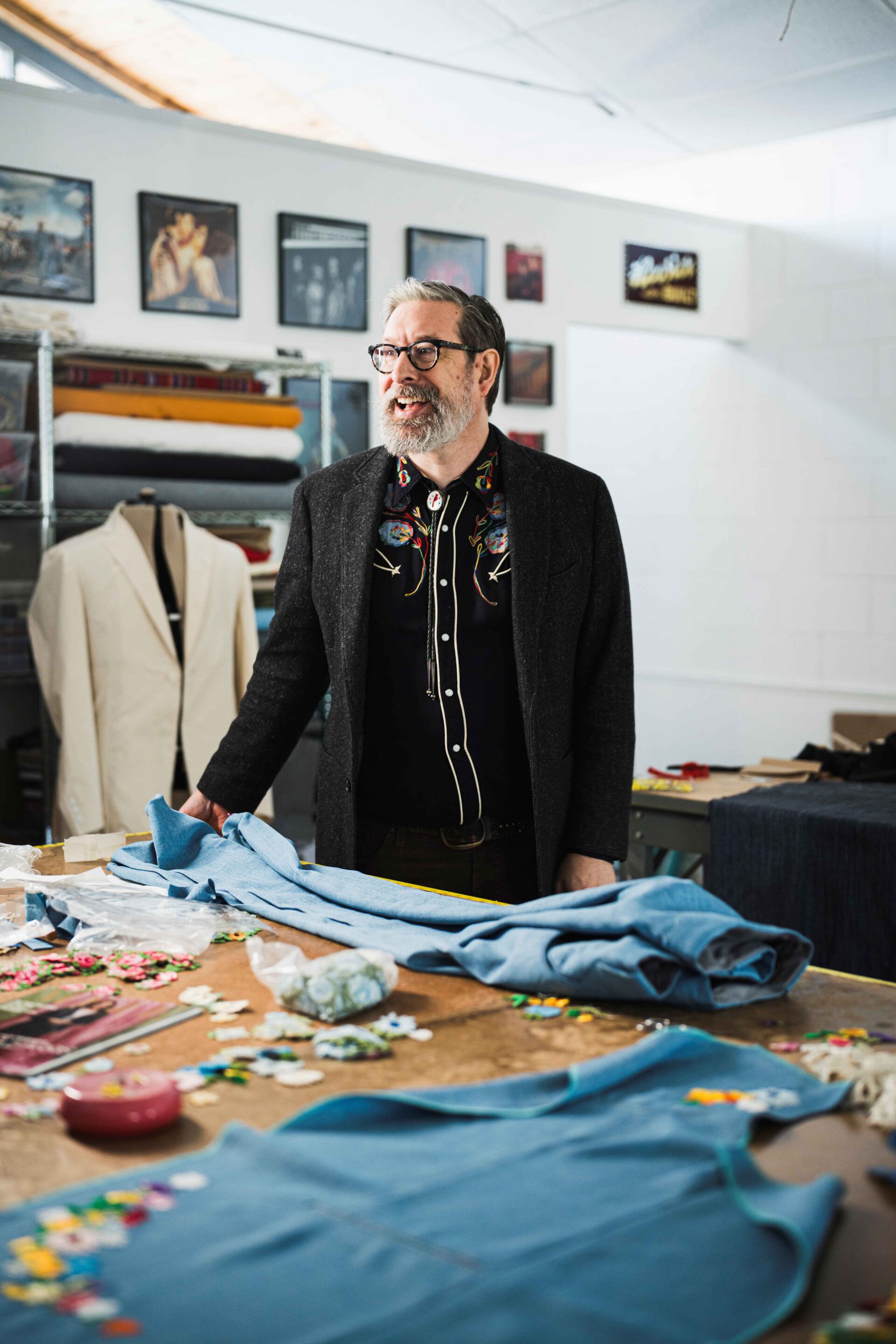
Jerry Lee Atwood in his Indianapolis design studio, Union Western Clothing. Image by Michael Durr.
By Bryan Corbin, Storyteller editor
A new exhibition merges the history of Western wear, the influence of country music on popular culture and the artistry of an Indianapolis fashion designer into an unforgettable experience.
Cowboy Couture: The Fashion of Jerry Lee Atwood opened March 28 at the Eiteljorg Museum. Visitors get an up-close look at a number of Atwood’s custom-made Western suits, many of them rhinestone-studded and blossoming with chain-stitch embroidery. Chart-topping musicians and entertainers, such as Lil Nas X and Post Malone, have sought out Atwood’s dazzling designs, wearing them on red carpets and in music videos. Perhaps the best-known Atwood creation is the embroidered rodeo-themed outfit with rhinestones and fringe that Lil Nas X rocked while line-dancing through the 2019 “Old Town Road” video. It racked up more than 1.4 billion views on YouTube, a fact that still amazes Atwood.
“People are always kind of surprised when they learn who I’ve made stuff for,” Atwood said with a modest shrug in his Indianapolis studio. “I don’t think a lot of people associate Indianapolis or the Midwest with fashion. I think it’s really cool that the museum can show people that you can live in a place like Indianapolis and make stuff that’s on a national and international stage. I’m thrilled to see it come together.”
The first museum exhibition to focus primarily on Atwood’s work, Cowboy Couture spotlights examples of his designs, weaving together the artist’s Indiana background, his fashion inspirations and his place within the long lineage of Western wear makers. Atwood takes a page from mid-20th century designers such as Nudie Cohn, Manuel Cuevas and others who gained fame for creating fancy, rhinestone-encrusted costumes for country music entertainers performing onstage at the Grand Old Opry, on TV shows or on music tours.
The first famous Western-wear designer, Rodeo Ben, created denim jeans outfits specifically for rodeo performers. The suits harken back to elaborate cowboy costumes worn by 19th– century performers in Wild West shows. This “Western” style was inspired by a combination of Mexican vaquero attire, adornments in Native American regalia, and practical clothing for grueling outdoor work.
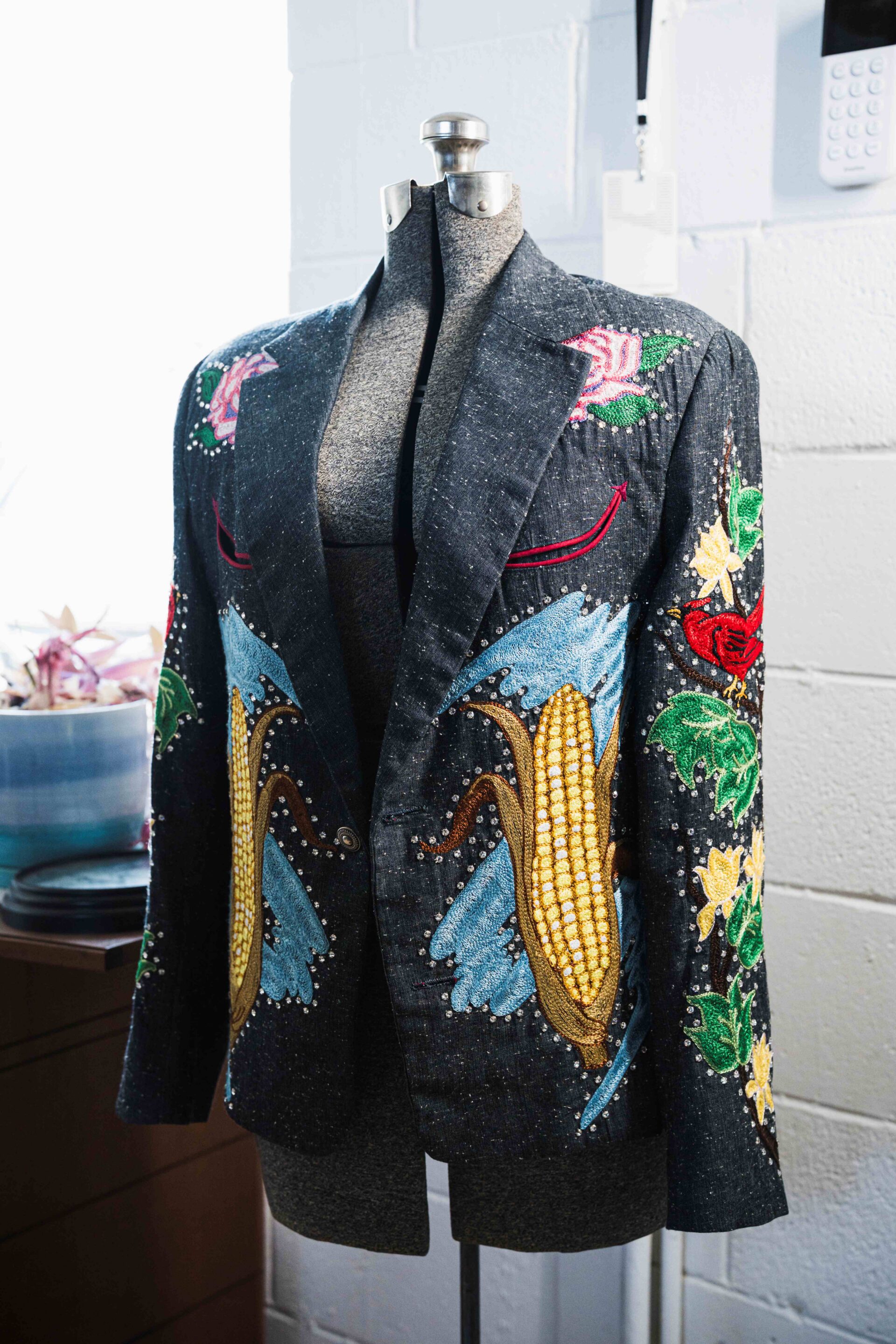
Indiana Suit designed by Jerry Lee Atwood. Image by Michael Durr.
Threads of Inspiration
Growing up in Lafayette, Indiana in the 1970s and ‘80s, Jerry Atwood was introduced to Country & Western music thanks to his father’s extensive record collection. On those album covers, and on TV shows he watched such as “Hee Haw” and “The Porter Wagoner Show,” country stars such as Wagoner and Webb Pierce amped up their showmanship by wearing wild, colorful embroidered outfits.
Years later, as a young struggling artist working as a barista in a coffee shop while hoping to pursue a design career, Jerry enjoyed hand-sewing embroidery projects when business was slow. One day a customer saw what he was working on, and gave him a book about the history of Western wear.
“I started flipping through it, and it brought back all these memories of going to (the Grand Ole Opry in) Nashville as a kid and seeing these musicians on my dad’s albums. And I just thought, ‘It’d be really cool to make one of these suits, or a fancy Western shirt,’” he said.
Atwood honed his sewing skills working in the costume shop of the Indiana Repertory Theatre as he experimented in creating Western wear. What started as a hobby evolved into a career designing and selling his custom-made Western suits for special occasions, such as weddings. Joe David Walters, a collector of vintage Western wear in London, England, saw Atwood’s designs and ordered a Texas-themed suit. Walters liked it so much that he became Atwood’s business partner, and they founded Union Western Clothing in 2013 in Indianapolis.
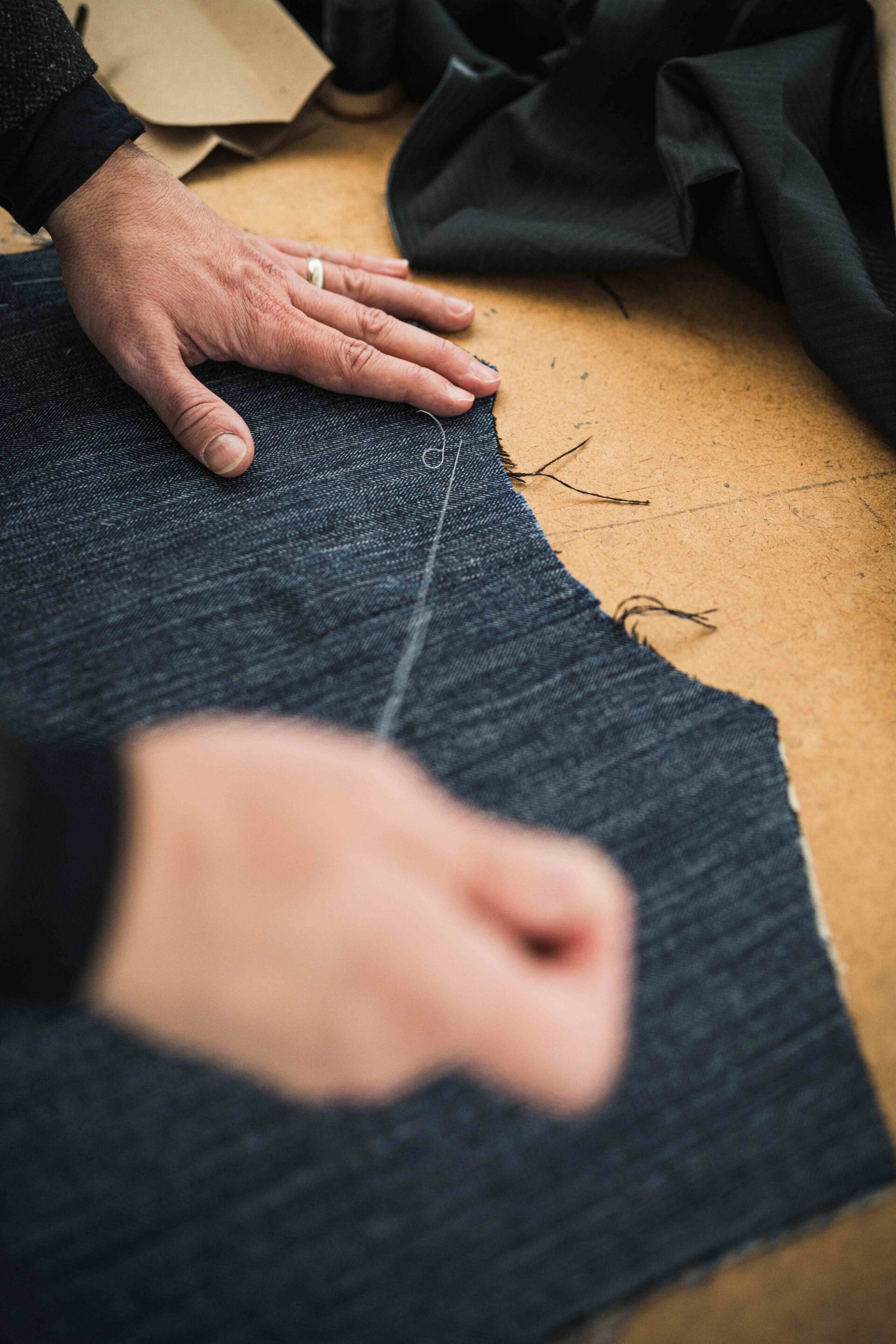
Jerry Lee Atwood, sewing in his studio. Image by Michael Durr.
In 2017, a Los Angeles stylist, Catherine Hahn, saw Atwood’s work on Instagram and commissioned him to create a light blue suit with embroidered snakes and barbed wire for singer Post Malone. Atwood’s first celebrity client, Malone wore it at the American Music Awards in 2018. That led to design requests from other entertainers, including the last-minute order for the “Old Town Road” suit, which Atwood had only three days to create out of materials he had on hand. Other entertainers who have worn Union Western suits include Orville Peck, Diplo, Charley Crockett, Nikki Lane and actor David Harbour from the Netflix hit series Stranger Things. Since many of his clients are based in L.A., New York or Austin, Texas, Atwood works more closely with celebrity stylists than the stars themselves; he designs and sews suits in his Indianapolis studio, then ships them.
All those efforts led to his achieving a personal bucket-list item in 2021: Atwood and Union Western were featured in a Vogue magazine spread, which he considers one of the highlights of his career.
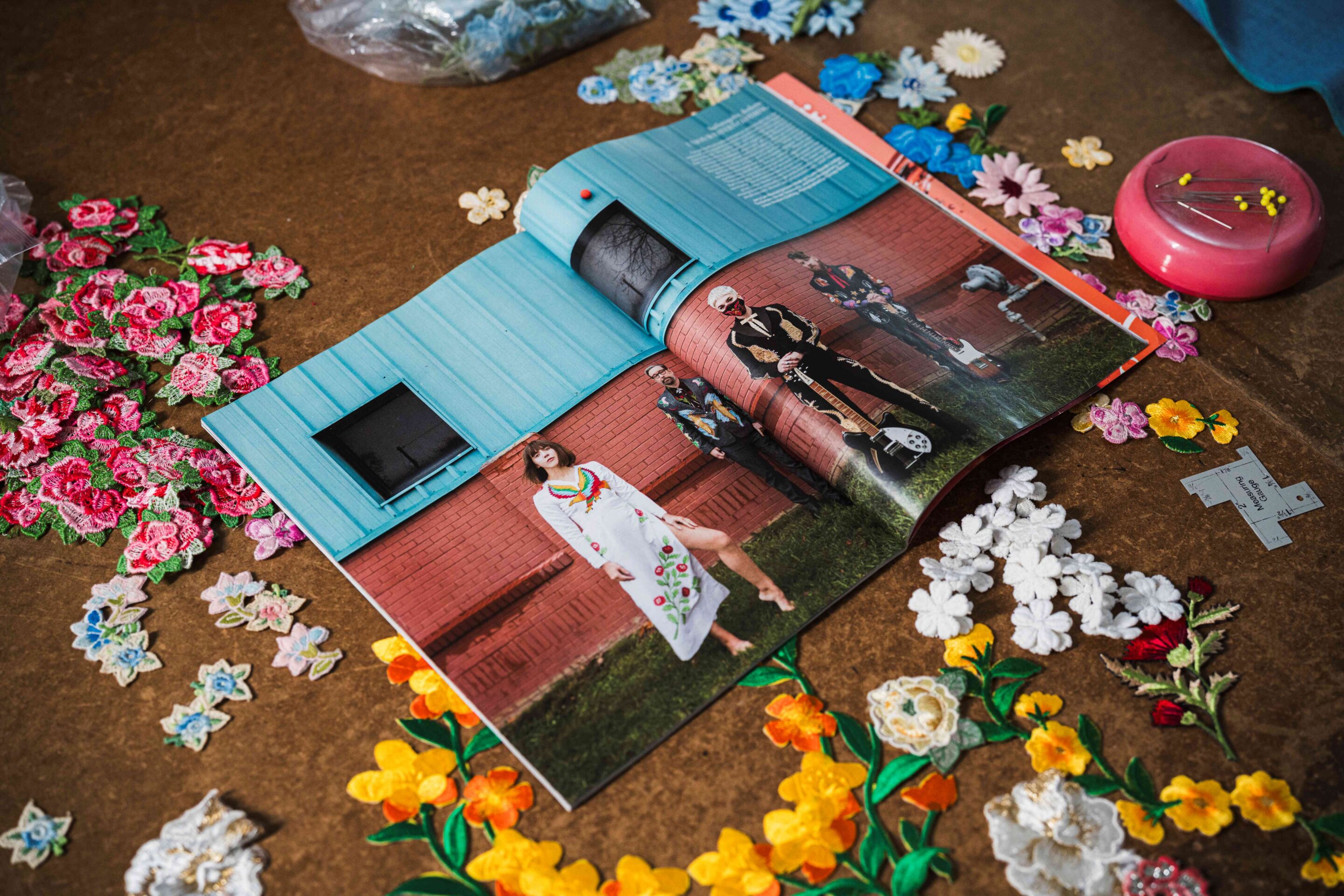
Jerry Lee Atwood’s designs were subject of a Vogue magazine spread in 2021. Image from Atwood’s studio by Michael Durr.
Letting the colors speak
The Eiteljorg’s Cowboy Couture exhibit follows the workflow of Atwood’s design process. First he asks for reference material about the client’s life story to sketch an initial design. Fabric selection varies based on the client’s budget. With a projector he mocks up the design sketch onto a dress form. The client’s stylist usually provides the measurements. “Once it gets to the embroidery machine, it’s just whatever colors speak to me,” Atwood said. Since he is colorblind, “a lot of people say that I use color in an interesting way in my work. I never know if that’s a good thing or a bad thing, it’s something I’ve adapted to; I’ve never seen it as a handicap.”
In his studio surrounded by scores of spools of thread, bolts of fabric, mid-20th-century Americana, and antique sewing machines — the oldest from 1932 — Atwood said that each Union Western suit takes approximately 120 hours to design and sew. Depending on the fabrics and density of embroidery, a suit can cost $2,500 to $8,000.
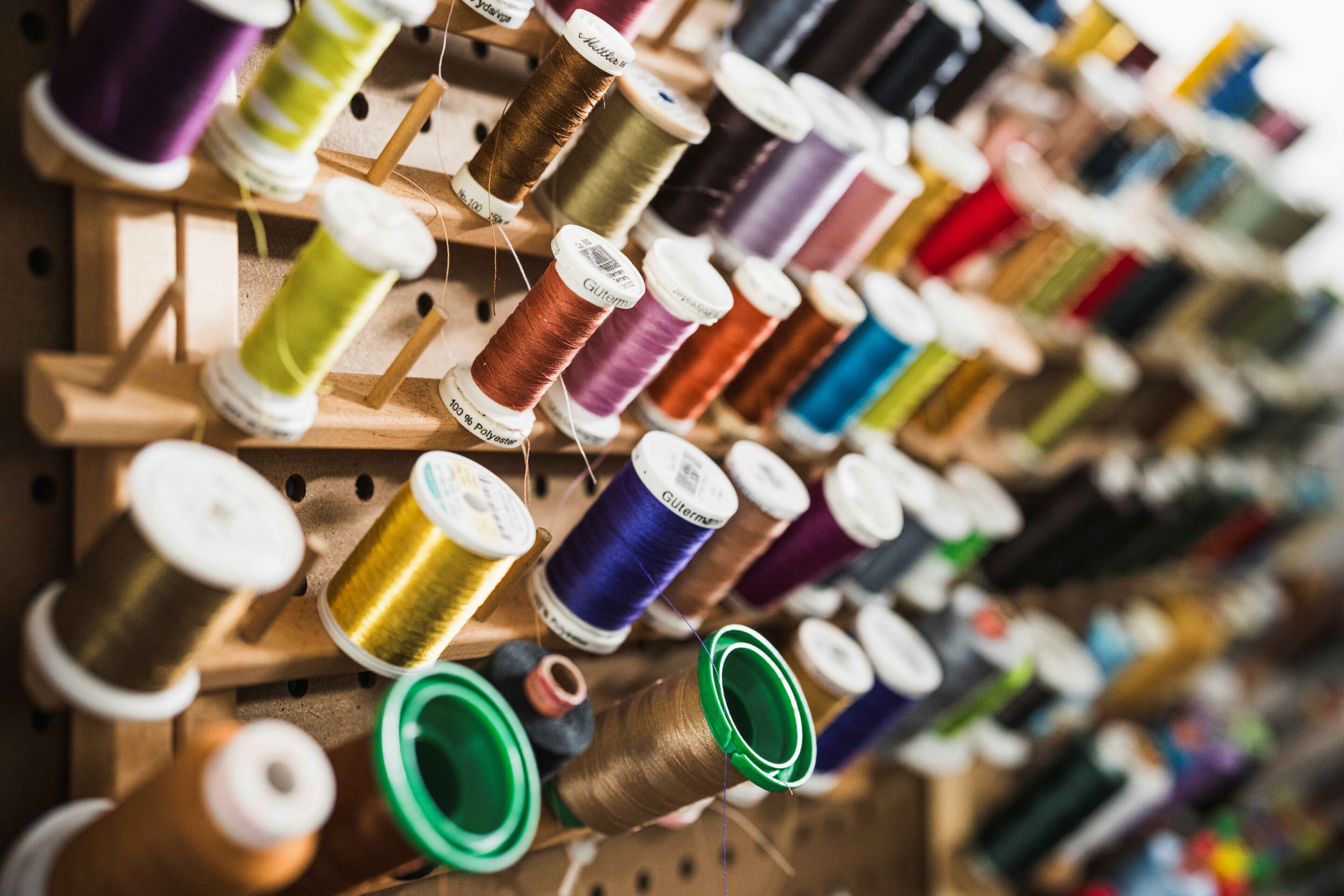
Spools of thread at Jerry Lee Atwood’s studio, Union Western Clothing. Image by Michael Durr.
Uniting a suite of suits
Since Atwood has designed customers’ suits over a period of years, the Cowboy Couture exhibition will be a remarkable opportunity for Eiteljorg visitors — and for Atwood himself — to see some of his older and recent designs gathered into one place. They will be accompanied by vintage Western outfits by Nudie Cohn and Manuel Cuevas, plus historic forerunners to those garments, as well as items from Atwood’s studio, such as his sketches, that reflect the designer at work.
“Jerry Lee Atwood stands at the crossroads of Western-wear fashion history and contemporary pop culture. While Western wear has long been considered a niche interest, Atwood’s designs have reached mainstream audiences. His presence in Indianapolis underscores a powerful message: Creativity and success aren’t confined to fashion capitals, and there are viable alternatives to fast fashion,” said Bryn Foreman, associate curator of Western American art at the Eiteljorg.
“Atwood blurs the line between costume and clothing, expanding the cowboy myth to embrace a broader, more inclusive vision of Americana. His work brings together past and present, inviting us to imagine a future where fashion is personal, expressive and sustainable,” Foreman added.
For the Eiteljorg Museum, the Cowboy Couture exhibition is an important milestone, celebrating local design that has an international reach.
“I hope that people walking into (the exhibit) will appreciate the historical context of it, but also the lasting power of this style of suit — and see up close all the work that goes into it,” Atwood said. “In a photo, you don’t see the dimensionality of the embroidery, how the light refracts off the rhinestones … the little handwork that goes into the tailoring.”
He added, “That’s the takeaway, too, that fashion at its core is art. Actual tailored suits and clothing are as much art as is a painting — especially since everything I make literally starts with a drawing. I really want people to see that whole process.”
Cowboy Couture: The Fashion of Jerry Lee Atwood, open now, runs through Aug. 2 at the Eiteljorg, and is sponsored by Avis Foundation, Inc., Capital Group and the Braitman family, with additional support from the Frenzel Family Foundation, Virginia Merkel, the Ann W. King Fund (a fund of the Indianapolis Foundation), and Richard Hailey and Mary Beth Ramey. It’s included with regular museum admission.
COWBOY COUTURE: THE FASHION OF JERRY LEE ATWOOD
THROUGH AUG. 2
Special Exhibitions Gallery
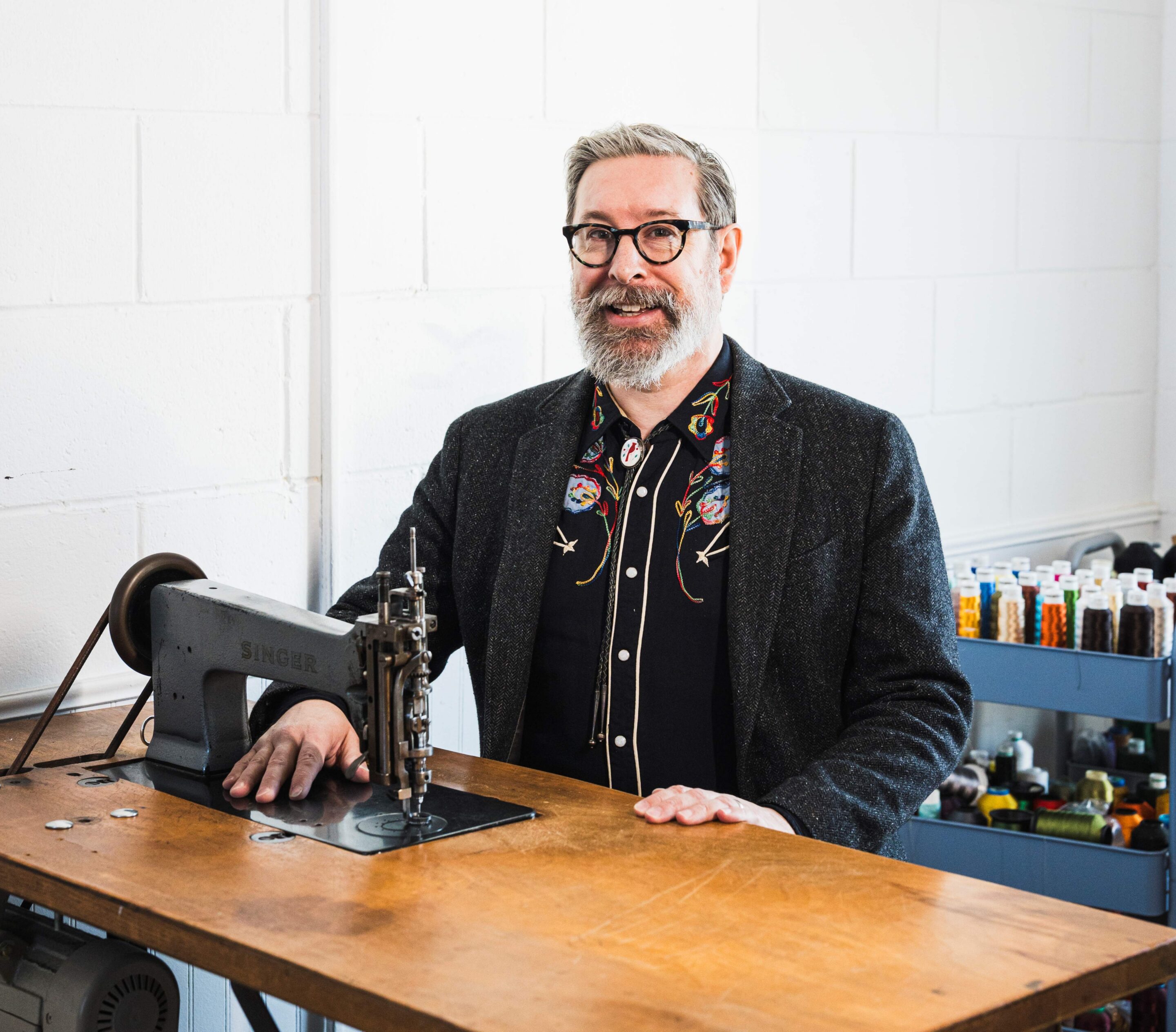
Jerry Lee Atwood with an embroidery machine at Union Western Clothing. Image by Michael Durr.
Editor’s Note: This article originally appeared in the February 2026 print edition of Storyteller magazine.